Remote Healthcare Hiring: How Telehealth Is Changing Recruitment Strategies

Remote healthcare hiring is rapidly transforming how healthcare organizations attract and retain clinical talent. As telehealth adoption accelerates, a growing number of providers, and every forward-thinking physician recruiter, are recognizing that geography is no longer the defining constraint in workforce planning. Instead, healthcare organizations are tapping into a broader, more flexible talent pool while rethinking traditional recruitment models, licensing frameworks, and competitive strategies.
Telehealth is not just a care delivery innovation, it’s a workforce revolution. From enabling clinician recruitment nationwide to redefining how a physician staffing agency operates, virtual care is reshaping every layer of healthcare hiring.
The Rise of Virtual Care Recruitment
After surging during the COVID-19 pandemic, telehealth usage rates have stabilized at levels significantly higher than pre-pandemic norms. In fact, weekly usage grew from 25% in 2018 to 71% in 2024. This shift signals a fundamental change: healthcare delivery is no longer tied exclusively to physical facilities. As a result, the telehealth talent pool has expanded dramatically.
Key developments include:
- Growth beyond primary care into specialties like psychiatry, radiology, and dermatology
- Increased patient and provider acceptance of virtual care
- Health systems integrating telehealth into long-term care models.
Telehealth is improving recruitment and retention by enabling providers to serve patients remotely, especially in underserved areas.
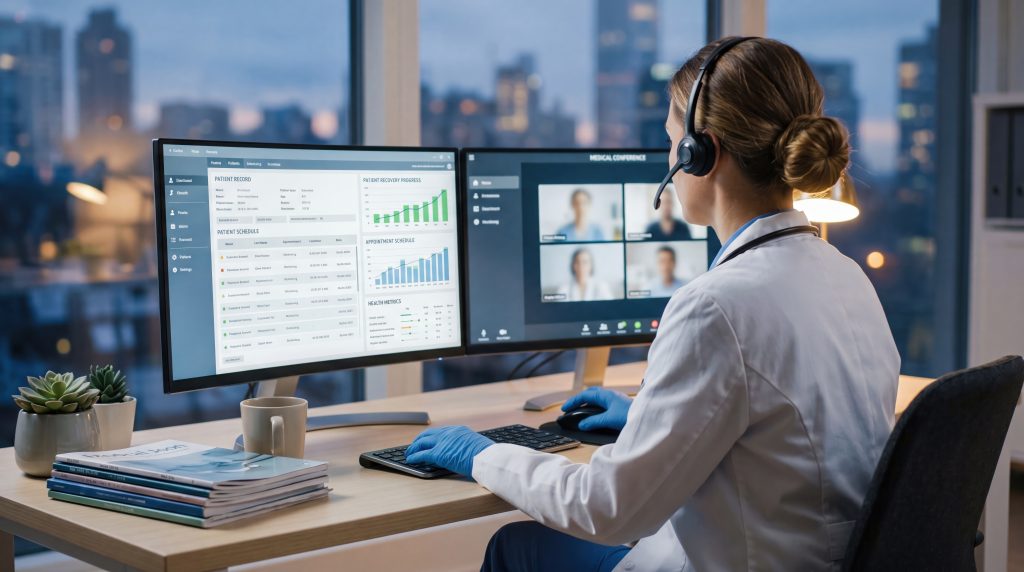
Healthcare Remote Jobs: The Expanding Telehealth Talent Pool
One of the most immediate impacts of telehealth is the removal of geographic barriers in hiring. Healthcare remote jobs are now accessible to clinicians who may have previously been excluded from traditional roles.
These include:
- Semi-retired physicians seeking flexible schedules
- Caregivers needing work-from-home opportunities
- Rural providers looking to supplement income
- Specialists interested in part-time or hybrid roles.
For hard-to-fill specialties, virtual care recruitment has proven especially valuable. Telehealth enables providers to scale services without requiring relocation, significantly reducing friction in the hiring process. From a telehealth physician recruiter perspective, this opens up a national pipeline of candidates who can be matched based on skill, availability, and licensure—not just proximity.
Challenges in Multi-State Physician Licensing
Despite its advantages, telehealth introduces new complexities, particularly around multi-state physician licensing. Healthcare in the U.S. remains regulated at the state level, meaning clinicians must be licensed in each state where patients are located. This creates administrative burdens for organizations engaging in digital healthcare hiring.
Key challenges include:
- Time-intensive credentialing processes
- Variability in state regulations
- Ongoing compliance requirements.
Interstate compacts, such as the Interstate Medical Licensure Compact (IMLC) and the Nurse Licensure Compact, aim to streamline this process. However, adoption is not universal, and administrative overhead remains significant.
These efficiencies are especially crucial for improving rural digital healthcare hiring and meeting the needs of chronically underserved populations. According to the Rural Health Information Hub, telehealth programs that proactively address licensing barriers are more successful in scaling recruitment and retention efforts.
For any physician staffing agency or healthcare employer, telehealth workforce planning must include a clear licensing strategy to avoid delays and compliance risks.

How Telehealth Recruitment Strategies Are Evolving
Telehealth is fundamentally reshaping telehealth recruitment strategies, pushing organizations toward more agile, technology-driven approaches.
National vs. Local Recruiting Models
Organizations are shifting from local hiring to clinician recruitment nationwide, leveraging virtual platforms to source candidates across the country.
Digital-First Recruitment Processes
From virtual interviews to remote onboarding, digital healthcare hiring has become the norm. This improves speed-to-hire and enhances the candidate experience.
Emergence of New Role Types
Telehealth has created entirely new positions, including:
- Telehealth physicians
- Virtual care coordinators
- Remote triage nurses
Employer Branding for Remote Appeal
To compete effectively, organizations must position themselves as attractive employers for remote clinicians—highlighting flexibility, technology infrastructure, and work-life balance.
A strong partnership with a physician recruiter or telehealth-focused staffing expert can help organizations refine these strategies and remain competitive.

Rising Competition Across Regions in Digital Healthcare Hiring
With the rise of remote healthcare hiring, competition is no longer confined to local markets. Healthcare organizations are now:
- Competing nationally for the same candidates
- Recruiting across urban and rural boundaries
- Facing pressure to standardize compensation.
This shift has led to:
- Salary normalization across regions
- Increased expectations for flexibility
- Greater emphasis on total compensation packages.
At the same time, retention has become more complex. Remote clinicians may have more options, making engagement and long-term alignment critical.
Strategic Opportunities for Clinician Recruitment Nationwide
While telehealth introduces challenges, it also creates powerful opportunities for organizations willing to adapt.
Building Flexible Workforce Models
Blending in-person and virtual roles allows organizations to optimize coverage and improve clinician satisfaction.
Addressing Staffing Shortages
Telehealth enables faster deployment of clinicians into underserved areas without requiring relocation.
Partnering with Physician Staffing Agencies
A specialized physician staffing agency or telehealth physician recruiter can:
- Accelerate hiring timelines
- Provide access to pre-vetted candidates
- Offer market intelligence on compensation and trends.
Creating Hybrid Care Models
Hybrid roles allow clinicians to split time between virtual and in-person care, improving both access and continuity.

The Future of Remote Healthcare Hiring
Remote healthcare hiring is no longer a temporary trend. It is a foundational shift in how healthcare organizations operate and compete for talent.
Telehealth has expanded the talent pool, introduced new workforce models, and intensified competition across regions. At the same time, it has created opportunities to build more flexible, resilient, and scalable healthcare systems.
Organizations that succeed with this backdrop will be those that:
- Embrace telehealth recruitment strategies
- Invest in telehealth workforce planning
- Partner with experienced recruiters and staffing experts
- Adapt quickly to regulatory and market changes.
For candidates, telehealth offers unprecedented access to opportunities, flexibility, and career mobility. For employers, it’s a chance to rethink hiring—not as a local challenge, but as a national strategy.