Ambient AI in Healthcare: How AI Scribes Are Changing Clinical Documentation
Clinicians have long sought a solution for the endless paperwork that steals their precious time. The wait is over. Ambient AI in healthcare is changing how clinicians document patient encounters, offering a way to reduce administrative work and keep attention on patient care.
For healthcare employers and medical recruiters, this technology is becoming a factor in being able to attract and retain qualified professionals. These AI tools offer new ways to streamline medical documentation and improve clinician efficiency reshaping clinician satisfaction and strengthening the patient-physician relationship.
What is ambient AI in healthcare?
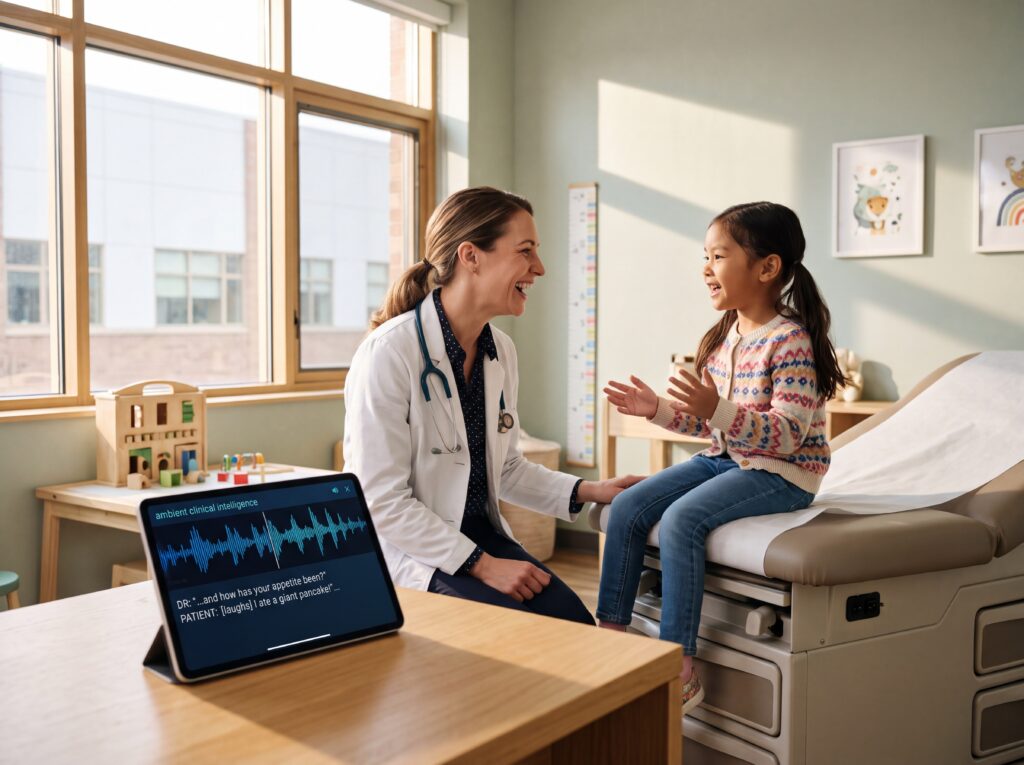
Ambient AI uses artificial intelligence to listen to clinical conversations in real time and generate draft documentation. Rather than requiring clinicians to type notes into an electronic health record (EHR) during appointments, these systems capture relevant details for review.
An AI medical scribe can summarize patient concerns, document medical histories, and draft assessment and treatment plans. Clinicians review and approve the notes before they become part of the medical record.
Unlike diagnostic AI, which analyzes information to support clinical decisions, ambient AI primarily assists with documentation and administrative tasks. It supports rather than replaces professional medical judgment.
Why are clinicians paying attention to ambient clinical documentation?
Documentation remains a significant administrative burden for healthcare professionals. Physicians spend considerable time navigating EHR systems, completing notes, and managing paperwork after appointments.
According to a 2026 multisite study, primary care and advanced practice clinicians benefitted the most from changes associated with AI scribe adoption.
The potential benefits of healthcare AI for clinicians
By automatically generating draft notes, ambient AI can reduce repetitive data entry and improve clinician efficiency.
Potential benefits include:
- More patient-focused appointments: Clinicians can maintain eye contact instead of concentrating on screens.
- Reduced cognitive burden: Automating documentation frees mental capacity for clinical decisions and patient communication.
- Improved workflow: Faster note generation may reduce documentation backlogs.
- Better work-life balance: Less after-hours documentation could help address physician burnout.
The benefits extend beyond physicians. A September 2026 report from Becker’s Hospital Review describes health systems expanding ambient AI into nursing workflows. In fact, a pilot across three units of one hospital group was associated with a 22% reduction in flowsheet documentation time per shift.
What are the risks and concerns surrounding healthcare AI?
Research suggests that ambient AI can reduce documentation time and cognitive workload while improving clinician efficiency. However, the extent of these benefits varies by system, clinical setting, and implementation.
- Accuracy: AI can misinterpret terminology, misunderstand context, or omit important details, potentially introducing errors into medical records.
- Patient consent: Patients should understand when AI is listening and how their information will be used.
- Privacy and security: Employers must evaluate data storage, encryption, retention policies, and vendor access.
- Clinician oversight: Professionals remain responsible for reviewing and approving AI-generated documentation.

What should clinicians look for in an AI medical scribe?
Healthcare organizations should evaluate several factors before introducing ambient clinical intelligence into their processes.
- Accuracy: Reliable recognition of clinical terminology and complex conversations.
- EHR integration: Compatibility with existing systems.
- Privacy protections: Clear policies for handling sensitive patient information.
- Human review: The ability to edit and approve generated notes.
- Ease of use: Technology that fits existing physician workflows.
- Organizational governance: Policies covering patient consent, security, and accountability.
Several companies demonstrate the expanding role of AI in clinical documentation and communication. For example, Scribe-X provides medical scribing services, while Heidi Health offers AI-powered tools for generating consultation notes.
DeepL offers AI translation capabilities that can help healthcare organizations address language barriers and communicate with patients whose primary language is not English. Translated clinical information still requires appropriate review for accuracy.

What ambient AI means for healthcare employers
Investing in ambient AI is also a recruitment and retention consideration. Clinicians value work environments that reduce administrative burdens and allow more time for patient care.
However, purchasing technology is only the first step. Employers must provide training, establish implementation policies, gather clinician feedback, and measure whether these tools actually improve workflow efficiency.
Attracting and retaining clinicians requires addressing the broader factors that influence job satisfaction. Technology cannot compensate for inadequate staffing, unrealistic schedules, or poor organizational culture.
The future of ambient AI medical documentation
Ambient AI is becoming an increasingly practical component of clinical documentation, with applications expanding beyond physicians into nursing and other healthcare settings. Research suggests it can reduce administrative burdens and improve workflow efficiency, but concerns about accuracy and patient safety remain.
Its long-term value will depend on reliable technology, appropriate privacy protections, effective implementation, and continued clinician oversight. Healthcare organizations should focus on using AI to make clinical work more manageable, support professional well-being, and improve patient care without compromising documentation quality.